.jpg)
For a long time, I've been uncomfortable with the use of the word "obedience" in regard to dog training. But I haven't been able to come up with an alternative that I like. I recently settled on "cooperation." I prefer the word "teach" to the word "train." Years ago, I discarded the word "command" in favor of "cue" or "cue word." Why does it matter? What difference does semantics make?
Let's look at the definitions (provided by YourDictionary.com) of the following pairs of words.
"Obedience":
1. the state, fact, or an instance of obeying, or a willingness to obey; submission
versus
"Cooperation"
1.the act of cooperating; joint effort or operation
I don't want blind obedience from my dogs, and I don't want submission. I want each dog to be a well-behaved partner and pal. I want my dogs to develop as the thinking creatures that they are. A service dog, for example, should not "obey" if doing so would place his handler in danger (example: handler asks the dog to guide him across the street but dog refuses because a speeding car is coming). An agility dog should not "obey" if doing so would put his own safety in jeopardy (example: dog steps onto a contact obstacle and then does not go up...later it is determined that the obstacle was not properly stabilized). Submissive behavior in dogs is an automatic response. I don't want my dogs on automatic; I want them thinking. In short, I want my dogs to have an attitude of cooperation. I want them to play/work with me because they want to, because it is fun and rewarding to do so, not because they "must."
"Train"
6. to discipline or condition (animals) to perform tricks or obey commands
versus
"Teach"
1.to show or help [someone] to learn...to do something
2.to give lessons, to guide the studies of; instruct
The word "discipline" has developed a connotation of punishment in common usage. In fact, self-discipline is a very positive thing. In the above definition, however, the implication is the the animal is coerced into performing or obeying. Certainly not how I want to teach my dogs. Teaching, as opposed to training, implies gentle guidance toward understanding. I want my dogs to understand their tasks rather than doing them because they "have to."
"Command"
1. (tv) to give an order or orders to; direct with authority
1. (iv) to exercise power or authority; be in control; act as a commander
versus
"Cue"
3. anything serving as a signal to do something
There is a subtle and not-so-subtle difference here. A command requires obedience. A command indicates that one individual has power over the other. There is a militaristic meaning inherent in the word. A command requires compliance. There is an implication that non-compliance is a bad thing and will result in a negative consequence, a punishment if you will. A cue is more forgiving. If my dog does not heed a cue, it is my responsibility to understand why that is so. Does the dog understand the given cue? Does the dog understand the cue in this particular setting? Does the dog understand the cue with distractions? I cannot assume understanding. Because I expect my dogs to live in my world (not a "natural" world for them), I must ensure that they understand the workings of that world. Through my signals, I provide them with direction and understanding. If a dog seems to ignore a cue, I have to examine whether or not it is completely understood. I have to give the dog the benefit of the doubt. No commands, just suggestions. Most of the time, the dog will realize that my suggestions make sense!
Thursday, February 25, 2010

Sunday, February 21, 2010

Saturday, February 20, 2010
Goofed Again
When I took Thor to his vet appointment, he pulled me eagerly into the building and wanted to greet a little bulldog who was just inside the door. Afterwards, he dragged me back outside. I was afraid of falling down he pulled so hard. Note to self: work on loose-leash walking!
The training I do with Thor in the house and in the (fenced) yard is all without a leash. No problem getting him to stay with me. But put a leash on him and he pulls, pulls, pulls. So yesterday I decided to take him with me (on lead) to walk to my mailbox (about 100 feet from my front door). I loaded up my pocket with lots of little bits of cheese and hotdog. I thought that with the food held in front of his nose, Thor would want to stay next to me. Wrong!
A neighbor's dog was tied out and barking, within our sight but 3 houses away. Thor found that very exciting. He pulled, he jumped, he circled me tangling me in the lead and knocking me to the ground. Between Thor's bouncing and pulling, and my weakness, it was several minutes before I was on my feet again. The return trip was equally difficult. When we got to the house, Thor tore up onto the porch slamming my hand into the porch railing. It hurt! After we got inside and Thor was back in his crate, I sat down and cried. My hand hurt, and I kept thinking I was in over my head with this big strong wild dog. Finally, my thoughts became calmer and I went online to find a front-clip harness.
The training I do with Thor in the house and in the (fenced) yard is all without a leash. No problem getting him to stay with me. But put a leash on him and he pulls, pulls, pulls. So yesterday I decided to take him with me (on lead) to walk to my mailbox (about 100 feet from my front door). I loaded up my pocket with lots of little bits of cheese and hotdog. I thought that with the food held in front of his nose, Thor would want to stay next to me. Wrong!
A neighbor's dog was tied out and barking, within our sight but 3 houses away. Thor found that very exciting. He pulled, he jumped, he circled me tangling me in the lead and knocking me to the ground. Between Thor's bouncing and pulling, and my weakness, it was several minutes before I was on my feet again. The return trip was equally difficult. When we got to the house, Thor tore up onto the porch slamming my hand into the porch railing. It hurt! After we got inside and Thor was back in his crate, I sat down and cried. My hand hurt, and I kept thinking I was in over my head with this big strong wild dog. Finally, my thoughts became calmer and I went online to find a front-clip harness.
Thursday, February 18, 2010
Setbacks (and I Goof)
After 17 days of a dry crate, Thor peed in his crate once more. I don't think I had changed anything re frequency of trips out. I may have taken his water away a bit later than usual. But I'm puzzled and waxing philosophical. I do believe that for learning to be solidified, backsliding is inevitable. In fact, setbacks are an important part of the learning process. To forget (or seem to forget) and then relearn makes a behavior more reliable. When I was taking piano lessons, my teacher would have me learn a piece well, then put it away and forget about it. Weeks later, she would bring it out again and have me relearn the piece. I think that was a wise way of teaching. So if I can let myself believe that Thor's "accident" will make his housetraining stronger, then that is what I'll believe.
With the schedule for taking Thor outside that I have set up, I am exhausted. Then, when he did his backsliding, I was exhausted, discouraged, a little bit angry. So the next time I was working on his obedience skills, I got a bit rough with him (pushed him into a sit when he didn't sit "fast enough" for me). He was shocked. He froze and didn't want to get up again. Poor Thor. I know better! I need to get some sleep so that I don't slip again into those old training patterns. I am committed to positive training!
For the most part, Thor's obedience skills are coming along very well. He sits when I cue him to sit, he offers a sit when he's unsure of what to do. I've been teaching him to maintain position (sit) until a verbal release (okay) without my having to say "stay." That's the expectation in shutzhund, and I like it. One of the first books I read about drive and allowing the dog to push the training was Shutzhund Obedience: Training in Drive by Sheila Booth with Gottfried Dildei. I later read Sheila's book, Purely Positive Training. These were among my introductions to a better/kinder way of training. I later attended a puppy training workshop presented by Sheila, and we've had several conversations at agility trials. If I could be half the trainer that Sheila is...
With the schedule for taking Thor outside that I have set up, I am exhausted. Then, when he did his backsliding, I was exhausted, discouraged, a little bit angry. So the next time I was working on his obedience skills, I got a bit rough with him (pushed him into a sit when he didn't sit "fast enough" for me). He was shocked. He froze and didn't want to get up again. Poor Thor. I know better! I need to get some sleep so that I don't slip again into those old training patterns. I am committed to positive training!
For the most part, Thor's obedience skills are coming along very well. He sits when I cue him to sit, he offers a sit when he's unsure of what to do. I've been teaching him to maintain position (sit) until a verbal release (okay) without my having to say "stay." That's the expectation in shutzhund, and I like it. One of the first books I read about drive and allowing the dog to push the training was Shutzhund Obedience: Training in Drive by Sheila Booth with Gottfried Dildei. I later read Sheila's book, Purely Positive Training. These were among my introductions to a better/kinder way of training. I later attended a puppy training workshop presented by Sheila, and we've had several conversations at agility trials. If I could be half the trainer that Sheila is...
Wednesday, February 17, 2010
Naming Thor
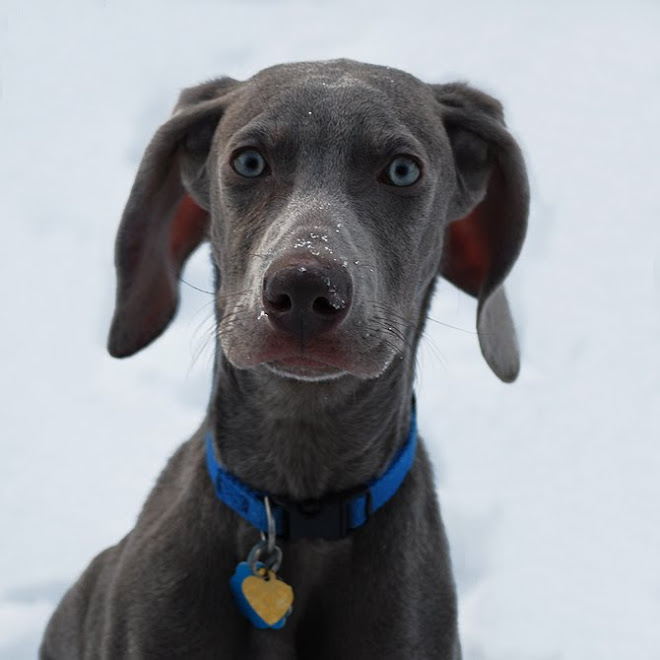
One of the good things that Thor learned in his previous home was name recognition. He knows his name and runs to me when he hears it.
I've been looking over Thor's AKC registration paper and thinking about giving him a more formal registered name. Since he knows his name and has a good association with it, I don't want to change it. Normally, I make it a policy to change the name of a rescue dog so they get a fresh start. I don't think that's necessary with Thor. I'm thinking of making it Thoreau which has good associations for me because of Walden Pond. My sister says it's too "regal" of a name for a goofy dog. She likes Thornton. I told her that Thor is only goofy because he is a puppy, but he will grow into any name.
The article in Dog World (March 2010), uses the following words in describing weimaraners: aristocratic, courageous, intelligent, elegant. And from the AKC Complete Dog Book: friendly, fearless, alert, and obedient.
I'm thinking "Lakewood Thoreau." Lakewood is the informal name of the neighborhood where I live. I like the connection to nature in keeping with Thoreau. And, of course, Thor was the god of thunder which suits him, too.
I can't let the subject of AKC trip by without a word of criticism. According to the AKC standard for weimaraners, the tail MUST be docked (a non-docked tail is a disqualification in the breed ring) and the dewclaws MUST be removed. I swore to myself years ago that I would not own a dog that was docked or cropped. I think it is outrageous that the AKC requires the maiming of certain breeds. I also think that both tails and dewclaws have specific purposes, especially in a performance dog. I suspect that dogs without them are at a disadvantage when jumping and turning at speed.
It makes me want to cry when I look at Thor's docked tail, hairless where the cut was made. And I wonder if, like human amputees, dogs who are docked and/or cropped feel phantom pain? Has anyone ever looked into this?
I've been looking over Thor's AKC registration paper and thinking about giving him a more formal registered name. Since he knows his name and has a good association with it, I don't want to change it. Normally, I make it a policy to change the name of a rescue dog so they get a fresh start. I don't think that's necessary with Thor. I'm thinking of making it Thoreau which has good associations for me because of Walden Pond. My sister says it's too "regal" of a name for a goofy dog. She likes Thornton. I told her that Thor is only goofy because he is a puppy, but he will grow into any name.
The article in Dog World (March 2010), uses the following words in describing weimaraners: aristocratic, courageous, intelligent, elegant. And from the AKC Complete Dog Book: friendly, fearless, alert, and obedient.
I'm thinking "Lakewood Thoreau." Lakewood is the informal name of the neighborhood where I live. I like the connection to nature in keeping with Thoreau. And, of course, Thor was the god of thunder which suits him, too.
I can't let the subject of AKC trip by without a word of criticism. According to the AKC standard for weimaraners, the tail MUST be docked (a non-docked tail is a disqualification in the breed ring) and the dewclaws MUST be removed. I swore to myself years ago that I would not own a dog that was docked or cropped. I think it is outrageous that the AKC requires the maiming of certain breeds. I also think that both tails and dewclaws have specific purposes, especially in a performance dog. I suspect that dogs without them are at a disadvantage when jumping and turning at speed.
It makes me want to cry when I look at Thor's docked tail, hairless where the cut was made. And I wonder if, like human amputees, dogs who are docked and/or cropped feel phantom pain? Has anyone ever looked into this?
Monday, February 15, 2010
The Importance of Balls, Part II
Since his purchase, Thor has had recurring drippy eyes. When his previous owners brought this concern up with the vet, they felt it was not taken seriously. So, during Thor's vaccination visit last week, I brought it up again. The vet's response was that the tear ducts could be flushed while Thor is anaesthetized for neutering. I informed her that I would be delaying neutering until Thor was around a year old. The vet objected to this, saying that 5 months was the optimal age. Having worked in an animal shelter for three years, I fully understand the problems of pet overpopulation and the importance of canine sterilization. I participated in the euthanasia of hundreds of unwanted animals. The shelter where I worked was a proponent of early-age spay/neuter and had a policy of neutering all animals prior to placement. This meant that puppies and kittens were often being sterilized at 8 weeks of age. I did not come lightly to my decision to hold off on neutering Thor.
Chris Zink is a veterinarian who is well-known and respected for her knowledge of the canine athlete. She has written extensively on canine structure and how it relates to athletic performance in dogs. I own two of her books which are extremely informative. In the packet that was provided by Thor's breeder was an article on the importance of waiting to neuter a weimaraner pup. As it turns out, it is all dogs who probably should be neutered after puberty. There are many deleterious effects of early (pre-pubescent) neutering of both males and females.
The first risk of early neutering is an alteration in the growth rate of certain bones. Apparently, growth plates are reliant on sex hormones to close at the appropriate time. Failure to close leads to abnormal growth which shows up as tall "leggy" dogs whose bones are not in the correct proportions to one another. As a result of this disproportion, dogs neutered prior to the development of adult sex hormones are more likely than those neutered later to develop hip displasia. In addition, one study showed that all neutered animals have a higher incidence of rupture of the anterior cruciate ligament. Both of these conditions may require surgery to repair.
Another study found that a variety of cancers occur at an increased rate in spayed and neutered canines. Those neutered prior to one year of aged had an increased risk of bone cancer. Since cancers are rampant on older dogs, I believe we must pay attention to these studies as one way to curb the incidence.
There are behavioral effects to early neutering as well. Those neutered early exhibited an increase (to my surprise) of sexual behaviors in both males and females. Noise phobias were increased in both genders while females developed more fearful behaviors in general, and males exhibited more aggression. I read long ago that dog aggression is most common between two spayed females.
As a result of my reading, and knowing that Thor will be well supervised and managed, I can only come to one conclusion. It is in the best interests of my dog to wait until one year (or thereabouts) prior to neutering.
Chris Zink is a veterinarian who is well-known and respected for her knowledge of the canine athlete. She has written extensively on canine structure and how it relates to athletic performance in dogs. I own two of her books which are extremely informative. In the packet that was provided by Thor's breeder was an article on the importance of waiting to neuter a weimaraner pup. As it turns out, it is all dogs who probably should be neutered after puberty. There are many deleterious effects of early (pre-pubescent) neutering of both males and females.
The first risk of early neutering is an alteration in the growth rate of certain bones. Apparently, growth plates are reliant on sex hormones to close at the appropriate time. Failure to close leads to abnormal growth which shows up as tall "leggy" dogs whose bones are not in the correct proportions to one another. As a result of this disproportion, dogs neutered prior to the development of adult sex hormones are more likely than those neutered later to develop hip displasia. In addition, one study showed that all neutered animals have a higher incidence of rupture of the anterior cruciate ligament. Both of these conditions may require surgery to repair.
Another study found that a variety of cancers occur at an increased rate in spayed and neutered canines. Those neutered prior to one year of aged had an increased risk of bone cancer. Since cancers are rampant on older dogs, I believe we must pay attention to these studies as one way to curb the incidence.
There are behavioral effects to early neutering as well. Those neutered early exhibited an increase (to my surprise) of sexual behaviors in both males and females. Noise phobias were increased in both genders while females developed more fearful behaviors in general, and males exhibited more aggression. I read long ago that dog aggression is most common between two spayed females.
As a result of my reading, and knowing that Thor will be well supervised and managed, I can only come to one conclusion. It is in the best interests of my dog to wait until one year (or thereabouts) prior to neutering.
Saturday, February 13, 2010
Vaccination
In the hubbub of changing homes and getting Thor settled in here, the date for his third distemper/parvo vaccine came and went. He was about a month late in receiving it when I took him in last Thursday. I had read information provided by the breeder about adverse reactions to vaccines in weimaraners which included the recommendation not to combine vaccines. Armed with that info, I asked if we could separate the distemper and parvo into two shots separated by a week in time. The vet told me that they don't get them that way so it wasn't possible. As long as we weren't doing the DP and rabies together, from what I read, it should be okay. So he had the vaccine. The vet also told me that, because of the delay, he would need to have a fourth shot.
Within a few hours of the injection, Thor had blowout liquid diarrhea. I thought back to hearing he'd been sick with diarrhea and vomiting in his previous home. So I contacted the previous owner to ask about the timing of that illness in relation to his DP vaccine. She verified that he had gotten sick within 48 hours of the injection. Later, I bumped into Thor, and he held his back leg up as if in pain for several moments. Turns out, painful joints and pain-to-touch are among the symptoms of an adverse reaction to vaccine along with diarrhea. Fever and lehargy can also occur. More serious reactions include seizures, muscular atrophy, incoordination and weakness. In the worst cases, death may result. Luckily, Thor did not exibit any of the severe symptoms. Still, the diarrhea was alarming to me in its severity. According to his previous owners, it was the earlier episodes of diarrhea that lead to Thor soiling his crate. No wonder.
Dr. Jean Dodds cites a recommendation to "refrain from vaccinating these animals [those who have had an adverse reaction to vaccine] until at least after puberty." The rabies vaccine is known to bring on neurological reactions in susceptible animals; the Weimaraner Club of America says that no weimaraner should receive the rabies vaccine prior to 6 month old. Thor was vaccinated at 4 months. His previous owners had presented the vet with the breeder's recommendation to wait another 2 months, but the vet insisted he have it earlier. Thor had a similar reaction (vomiting/diarrhea) to that vaccine.
Dr. Dodds conducted a study of weimaraners in which adverse reactions to vaccination included high fever, cyclic episodes of pain, diarrhea, lethargy, anorexia, enlarged lymph nodes, coughing, pneumonia, depression, seizures, refusal to stand or move. Most cases were in male puppies. Outcome for Dodds' subjects were good for half the group; other puppies died or remained chronically ill as adults. Going forward, measurement of titres is recommended along with avoidance of unnecessary vaccines and "tailoring a specific minimal vaccination protocol for dogs of breeds...known to be at increased risk for adverse reactions." The puppy series should be started later, at 9-10 weeks, according to Dodds. Avoidance of revaccination in dogs who have already had an adverse reaction is recommended. Needless to say, I called my vet and canceled the appointment for DP #4.
Thirty-six hours after the vaccine, Thor was much improved although he did vomit once beyond that time frame. During the first day and a half following vaccination, he ate significantly less than usual. For a puppy who normally doesn't notice pain (he does wipe-outs on the ice in my yard regularly and jumps up to keep on running), he was particularly sensitive to a minor bump. All in all, I wish I had investigated sooner the special needs of weimaraners and vaccination. I certainly will take a protective/proactive role in dealing with any veterinarian who questions the research.
Now two and a half days later, Thor seems to have fully recovered. Keeping my fingers crossed.
Within a few hours of the injection, Thor had blowout liquid diarrhea. I thought back to hearing he'd been sick with diarrhea and vomiting in his previous home. So I contacted the previous owner to ask about the timing of that illness in relation to his DP vaccine. She verified that he had gotten sick within 48 hours of the injection. Later, I bumped into Thor, and he held his back leg up as if in pain for several moments. Turns out, painful joints and pain-to-touch are among the symptoms of an adverse reaction to vaccine along with diarrhea. Fever and lehargy can also occur. More serious reactions include seizures, muscular atrophy, incoordination and weakness. In the worst cases, death may result. Luckily, Thor did not exibit any of the severe symptoms. Still, the diarrhea was alarming to me in its severity. According to his previous owners, it was the earlier episodes of diarrhea that lead to Thor soiling his crate. No wonder.
Dr. Jean Dodds cites a recommendation to "refrain from vaccinating these animals [those who have had an adverse reaction to vaccine] until at least after puberty." The rabies vaccine is known to bring on neurological reactions in susceptible animals; the Weimaraner Club of America says that no weimaraner should receive the rabies vaccine prior to 6 month old. Thor was vaccinated at 4 months. His previous owners had presented the vet with the breeder's recommendation to wait another 2 months, but the vet insisted he have it earlier. Thor had a similar reaction (vomiting/diarrhea) to that vaccine.
Dr. Dodds conducted a study of weimaraners in which adverse reactions to vaccination included high fever, cyclic episodes of pain, diarrhea, lethargy, anorexia, enlarged lymph nodes, coughing, pneumonia, depression, seizures, refusal to stand or move. Most cases were in male puppies. Outcome for Dodds' subjects were good for half the group; other puppies died or remained chronically ill as adults. Going forward, measurement of titres is recommended along with avoidance of unnecessary vaccines and "tailoring a specific minimal vaccination protocol for dogs of breeds...known to be at increased risk for adverse reactions." The puppy series should be started later, at 9-10 weeks, according to Dodds. Avoidance of revaccination in dogs who have already had an adverse reaction is recommended. Needless to say, I called my vet and canceled the appointment for DP #4.
Thirty-six hours after the vaccine, Thor was much improved although he did vomit once beyond that time frame. During the first day and a half following vaccination, he ate significantly less than usual. For a puppy who normally doesn't notice pain (he does wipe-outs on the ice in my yard regularly and jumps up to keep on running), he was particularly sensitive to a minor bump. All in all, I wish I had investigated sooner the special needs of weimaraners and vaccination. I certainly will take a protective/proactive role in dealing with any veterinarian who questions the research.
Now two and a half days later, Thor seems to have fully recovered. Keeping my fingers crossed.
Subscribe to:
Posts (Atom)